



Article summary:
We’re seeing a shift in the property CRM market from a single transaction perspective to a lifelong customer engagement perspective. With a fresh insight from the industry provided by Reapit’s leadership, the post considers the reasons why estate agencies are now required to treat every landlord, tenant, buyer, and seller as a long-term relationship, rather than a transaction to be closed and forgotten. It addresses the impetus for change, what can be gained from it, and the practical changes required to make it happen.
Introduction
For years, the real estate CRM was considered a glorified filing cabinet – where a lead is logged, a sale is tracked, and once signed on the dotted line, you move on. That’s a model that’s quickly becoming obsolete. Industry perspectives are now going so far as to say that the whole idea of a modern CRM system should be to create long-term relationships, not just one-off sales.
This thinking has also been heard from the leaders of Reapit, who complained that many PropTech businesses have a limited scope of consideration for their clients’ clients – the property owner, the property seeker, the tenant or the landlord. It’s a simple concept that can be forgotten: the most valuable resource of any agency is not a list of landed transactions, but a network of buyers, sellers, renters, and investors who could be interested in buying and selling again.
Letting Agent Today
From Transaction to Relationship
The move makes perfect sense when you think about the way people interact with property. A landlord owning one flat today can own a small landlord portfolio in 5 years. The first buyer becomes the first seller and then the first buyer again. A transaction-only CRM cannot predict when new stock will come onto the market, which is often desired by portfolio landlords.
Letting Agent Today
Any customer interaction, whether it’s a visit to a website, a text, a phone call, or a note copied during a viewing, is a signal. Such interactions serve as signals to know when someone may want to buy or sell. The goal, as mentioned in the same commentary, is amazing: to win a listing before the homeowner even knows they are looking to sell.
It is not just a matter of more software features that give a predictive edge. It’s based on the premise that the CRM is more of a living document that is updated on a regular basis, and not a static archive that is only edited at the beginning and end of a transaction.
Backing the Shift With Investment
It’s not just a talking point; it’s in the capital allocation. Reapit recently officially announced its latest investment, a bold declaration that it aims to move beyond transaction management to eventually become the primary provider in the market for agencies who will have a relationship with them before, during, and after the transaction. One component of that is the use of tools that keep the connection alive beyond the sale, providing a more complete, dynamic understanding of what each customer might need down the road based on continued monitoring of their behaviour.
What This Means for Agencies
Old CRM Approach | Lifelong Relationship Approach |
Tracks a single transaction | Tracks the entire customer journey |
Data goes stale after the sale | Data updates continuously via ongoing signals |
Customer contact ends at completion | Customer engagement continues indefinitely |
Focused on the agency’s immediate client | Extends to the client’s clients (tenants, buyers, landlords) |
Reactive: responds when contacted | Proactive: anticipates needs before they’re expressed |
Agencies who do this do not just seek repeat business; they’re proactive enough to find opportunities before other agencies are able to re-engage when their customers come back to them.
The Bigger Picture
As in other sectors, the emphasis is shifting in the healthcare sector from a single transaction towards a lasting relationship. Real estate, which has traditionally had long and recurring customer journeys, is likely a logical target for the same transformation; it simply took a while longer.
What’s more difficult for agencies would be more about changing the way you do things than acquiring new software – logging every interaction, believing the data enough to make a decision, and the tendency to file a contact away the second a deal drops off the table.
FAQs
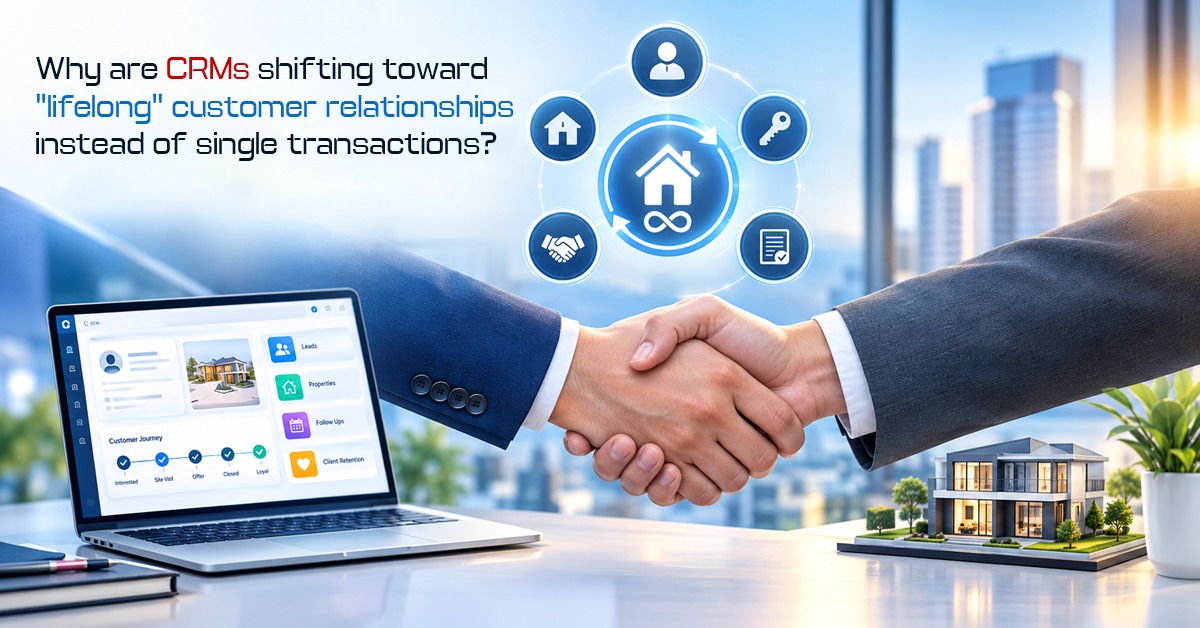
1. Why are CRMs shifting toward "lifelong" customer relationships instead of single transactions?
Most customers come back in some manner; a tenant becomes a buyer, a buyer becomes a seller. If each interaction is a single occurrence, all the value accumulated from previous interactions is lost.
2. What kind of data can a CRM use to make predictions about the needs of customers in the future?
Signs of behaviour such as visits to websites, notes taken during interactions, and calls and messages made can indicate when a person may be considering buying, selling, or renting again.
3. Is this a good idea for landlords and tenants, or for agencies only?
Both. Agencies will have more repeat business, but the customer will also be better served thanks to an earlier view on the opportunities that may arise, rather than being forgotten after a deal is done.
4. Does this trend apply to just one CRM provider?
No, although Reapit was the source of this article’s comments and investment, the trend toward 24/7 customer engagement is a more common occurrence in the PropTech industry in general.
5. What is the greatest barrier to the implementation of a lifelong relationship model?
It’s often about standard operating procedures, and not technology. Agencies should consistently record calls and take action on the data accordingly, not letting a contact go after making a sale.