



Introduction
A CRM system can be thought of as the hub of a business’s customer data. It can include contact information, sales data, chats, support tickets, purchase information, and more. Just because customer information is in one system doesn’t mean that it will lead to a better customer experience.
If this information is incomplete, outdated, duplicated, or not tied to real business processes, a CRM can add to the confusion. There can be a different path that a customer takes from the sales team and another path from the support team. Marketing can use “outdated” information, which often results in inconsistent communication.
The true power of the CRM is in consolidating the various pieces of information and turning them into a clear, actionable insight.
When More CRM Data Creates More Problems
The more that businesses expand, the more data customers are gathering. New leads are added, conversations are made on various channels, and the various departments make notes and records.
If the data isn’t managed correctly, the CRM can turn out to be messy in no time. Duplicate customer profiles, missing fields, inconsistent formats, and out-of-date contact information make it more difficult for employees to understand what is going on.
The more features or additional data collected, the more difficult this problem becomes. Processes are essential to ensure information flowing into the CRM is accurate, relevant, and useful to businesses.
To design One Connected Customer Journey.
Customers don’t see the business as separate departments; they see the business as a whole. Whether they’re talking to sales, reaching out to customer support, replying to an email, or placing an order, they can expect their interactions to feel connected.
Therefore, it is important to link these interactions in a well-designed CRM strategy.
For instance, whenever a customer calls support, the support team should be able to know what he/she has bought, sold, and complained about, or what he/she has talked about, without asking the customer to repeat all that.
Provides continuity and context for employees to be more effective.
Automation should not be the first step—data quality should be. Automation should not be the first step; data quality should be.
One of the key advantages of the current CRM systems is automation. Follow up, lead assignments, notifications, customer communication, and reporting can be automated for businesses.
But automation dependent on poor data can just make wrong choices at a higher rate of speed.
Automated messages can get to the wrong person or deliver irrelevant information if the information in the CRM is inaccurate. When the leads are misled, salespeople can be given tasks at the wrong time.
Companies need to have specific data standards in place and eliminate data duplication, and customer records need to be reviewed regularly before automation is implemented.
Embed Systems into Your CRM
A CRM is not used on its own. It can be used in conjunction with accounting software, marketing applications, e-commerce software, communication applications, help desks, and analytics platforms.
If these systems are not integrated, workers will have to manually move data to and from platforms. This adds delays and an increased risk of errors.
CRM integration can integrate vital business systems and enable useful data to flow between them. The goal is not to just connect all the tools that can be integrated. Rather, businesses need to understand what types of connections truly enhance the customer journey and internal processes.
Use outcomes to measure, not activity.
The CRM’s dashboards can include the number of leads, calls, emails, opportunities, and closed deals. While these metrics are important, it is just as important for businesses to look at what these activities are achieving.
Important questions include:
- Is the follow-up to leads happening at the appropriate time?
- How fast do issues get fixed with customers?
- Where are prospects falling out of the sales funnel?
- What interactions result in conversions?
- Is information consistent with the customer?
These questions make CRM more than just tracking activity; they involve understanding customer outcomes.
Conclusion
The objective of a CRM is not just to be a bigger database for the business. Its role is to provide businesses with a deeper understanding of customers, to have a team working together, and to make informed decisions.
The best CRM approach is the one that includes some of the following characteristics: correct data, linked systems, transparent processes, significant automation, and useful analytics. If implemented together, businesses can minimize customer confusion rather than magnify it.
It’s not a ‘collect everything’ thing. It’s about providing the right information to the right people at the right time.
FAQs
1. A CRM may become hard to manage why?
Without proper data-management practices, a CRM can become challenging to use, as businesses will start to collect redundant data, stale information, inconsistent data, and irrelevant fields.
2. Does a large volume of customer data enhance customer experience?
Not automatically. The value of customer data is realized when it is accurate, relevant, accessible, and put to good use when interacting with customers.
3. Why is it that CRM integrations are important?
Integrations enable the CRM to integrate with other business systems, minimizing data duplication and providing access to relevant customer data for various workflows.
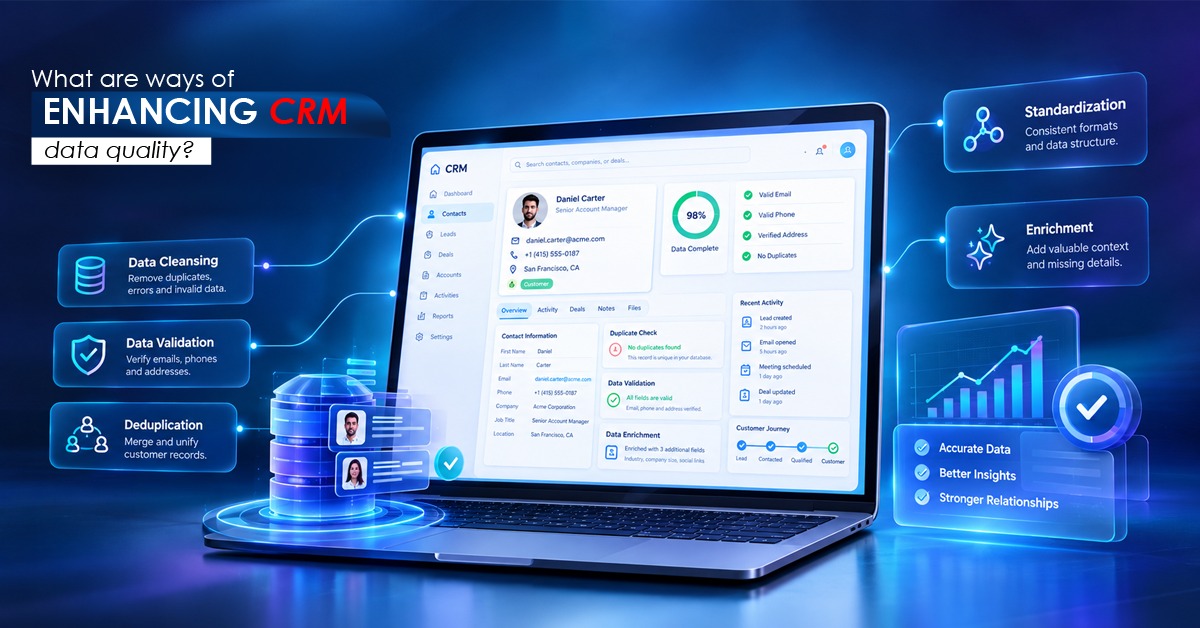
4. What are ways of enhancing CRM data quality?
Businesses can set up data entry standards, eliminate duplicate records, routinely update customer information, establish required fields, and verify data accuracy.
5. What are some things businesses should measure in CRM?
In addition to leads and sales activity, businesses can track response time, conversion rates, customer retention, issue resolution, follow-up performance, and more, all related to customer outcomes.