



Blog Summary
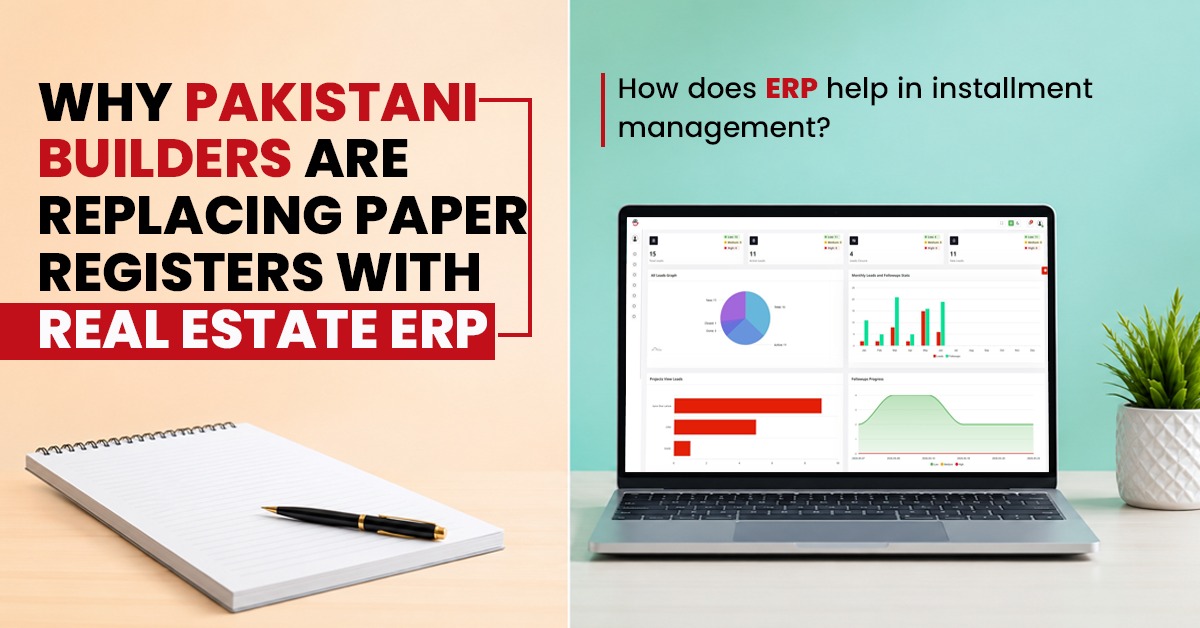
More and more builders in Pakistan are embracing Real Estate ERP software to eliminate the need for old registers, spreadsheets, and manual documentation. For more complex property projects, this can cause delays and mistakes when keeping track of bookings, customer information, payments, construction work, and stock. Real Estate ERP offers a unified digital solution that enhances accuracy, boosts efficiency, and simplifies real estate business management.
Introduction
Over the years, builders in Pakistan and property developers have been using paper registers for conducting daily business activities. Customer information, plot bookings, installment payments, and construction costs have continued to be essential features in real estate since registers were introduced.
There are significant management problems, however, with manual record keeping as a business expands and projects become more complex. It takes time and effort to search through multiple registers, update information, and keep all the records accurate.
It is for this reason that many property businesses are shifting towards Real Estate ERP software. Digital management systems for the builder can help them coordinate their work, cut down on paperwork and have more control over their projects.
1. Manual records raise the likelihood of errors.
There is a great reliance on the paper registers for accurate handwriting, calculations, and updates. If the payment entry, customer record or property booking is incorrect, it can lead to a problem later on.
Real Estate ERP software keeps data digital and ensures that it is organized. New information is available to authorized employees, and they don’t need to continually check multiple registers.
2. Improved time to property and customer information
It is difficult to locate a particular customer record or booking particular in real registers particularly in the event the company deals with various projects.
The ERP system maintains centralized customer information, property data, booking details, and transaction history. Staff members can find the information they need easily, leading to enhanced productivity and service to customers.
3. Improved Payments and Installments Transactions Monitoring
Management of the installments is one of the key duties of Pakistani Property Developers. It is important for builders to track payments received, the balance remaining, due dates, and customer payment history.
This can be challenging using manual registers, especially with hundreds of customers.
Real Estate ERP software can help you manage installment schedules, payments, invoices, and outstanding amounts. This helps the finance staff keep track of collections and enforce pending payments more effectively.
4. Improved Project and Construction Management
The use of single documents to oversee construction can be challenging when it comes to tracking progress and resource needs.
Real Estate ERP solutions can help with project planning, task management, construction documentation, and material tracking. Changes can be seen in a centralized system and can be assigned to responsibilities and monitored by managers.
This allows departments to coordinate more effectively and businesses to identify any delays in their operations.
5. Less paperwork and administrative work
Keeping things physical is a space-consuming process, and it involves manual data entry and regular record-keeping. Paperwork can begin to become cumbersome, especially as projects grow.
Digital ERP systems help to streamline critical data using electronic files, eliminating reliance on paper-based systems. Staff will have more time to dedicate to productive business activities and less time maintaining registers.
6. Stronger Financial Transparency
Financial information, if accurate, enables builders to know how they are doing in their business. Having sales and expenses, payments and accounts separated makes reporting difficult.
ERP software integrates financial operations and provides structured reports. With the updated information, management can analyse the relevant figures and track expenses; they can also make business decisions accordingly.
7. Better Customer Communication
When considering the purchase of a property, buyers want transparency when it comes to bookings, installment payments, and project progress updates. When customer records are stored in multiple registers, it takes longer to respond to questions.
Integrated CRM systems support businesses in keeping track of customer data, document interactions, arrange follow-ups, and enhance sales team-to-buyer communication.
The rationale for choosing digital management.
This transition from registers to Real Estate ERP is more than just a technology shift; it’s a journey. It’s about making it more accurate, increasing administrative ease, and setting businesses up for future growth.
As with other solutions, like Ladder ERP by SHE Technologies, the activities of business management can be organized with digital systems. Builders will want to consider the features, customization, reporting, security, and technical support of the platform before deciding on which platform to choose.
Conclusion
While traditional registers have been used for real estate businesses for decades, it is vital that growing projects have more organized and efficient management systems. Real Estate ERP software enables Pakistani real estate builders to handle property booking, payments, construction activities, finances, and customer relationships from a centralized platform.
The shift from paper to digital can enhance operational management, reduce time wasted on paperwork, and provide businesses with a solid foundation for future success.
FAQs
1. Pakistani builders are moving towards Real Estate ERP software for the following reasons
The implementation of ERP software by builders is helping to minimize paper workflows, ensure more accurate records, help with property transactions, and help them coordinate business operations better.
2. Can Real Estate ERP be used to replace manual property registers?
Yes. An ERP system can keep customer records, property bookings, payment details, installment schedules and more critical information in business digitally.
3. How does ERP help in installment management?
It facilitates the arrangement of the payment plan, logging the payments received, tracking amounts due, and keeping a history of customer payments.
4. Is Real Estate ERP perfectly capable of meeting the needs of small property developers?
Yes. ERP software can be utilized by small and medium enterprise developers to better coordinate day-to-day operations and manage business development.
5. What are the factors that should be taken into account by builders when choosing an ERP system?
The essential features, ease of use, customization options, financial reporting capabilities, data security, integration options, and technical support are among the key facets they should assess.