



Blog Summary
Real estate developers in Pakistan have to deal with a number of tasks such as project planning, construction tasks, financial data, property sales, and customer relationships. Manual handling can lead to delays, inaccuracies, and communication problems. By consolidating key business processes into a single platform, Real Estate ERP software empowers developers to streamline their operations, track projects, manage resources, and make data-driven decisions.
Introduction
The real estate business in Pakistan is complex and is a business which demands proper planning, coordination and financial management. Developers may work on several projects, deal with property bookings, oversee construction, organise staff, and deal with customer interactions and investor relations.
If these activities are controlled using individual spreadsheets, paper, or isolated systems, it can become hard to find key information. This can result in data duplication, update latency, and lack of visibility during operations.
Real Estate ERP software is an integrated solution that links departments and makes business operations easier. It assists property developers to run their projects more efficiently, with better controls over business operations.
Real Estate ERP Software—What Is It?
Real Estate ERP (Enterprise Resource Planning) Software is a digital management system that streamlines and automates vital business processes. Integrates sales, accounts, construction, inventory, HR, and customer management into a single system.
For Pakistani Developers, an ERP solution can streamline property-related tasks and enhance data flow, giving a better perspective of current projects.
Let’s explore these six ways real estate ERP can benefit Pakistani developers.
1. Centralizes Project Management
When development projects are numerous, tasks and deadlines must be continuously monitored, budgets must be kept on track, and resources must be allocated properly. ERP software enables developers to keep project data in one place.
Project managers can keep track of progress, allocate tasks, and check project updates without relying on a chaotic system of documentation. This enhances a team’s organizational and coordination skills.
2. Streamlines Property Sales and Booking
In property sales, there are customers’ queries, plot availability, booking information, installment schedules, and payment records. This can be difficult to keep track of on your own as a project expands.
A real estate ERP system makes a property stock, booking records, customer information, and promoting exercises much easier to take care. Teams have access to current information and can manage transactions more efficiently.
3. Improves Financial Management
Financial transparency is a key component for real estate developers. Proper records help with making better financial decisions, whether it’s in tracking customer payments or in keeping an eye on project expenses.
ERP software can be utilized to control accounts, invoices, past-due payments, and financial reporting. It helps to give a clear picture of cash flow and helps management to monitor their financial activities.
4. Records construction and inventory activities.
There is a need to coordinate materials, equipment, labour, and suppliers for a construction project. Failure to manage inventory can impact project schedule and productivity expenses.
An ERP system can help companies track stock levels, make purchases, and record material use, as well as organize construction-related activities. This helps to plan resources more efficiently and avoid any needless delays.
5. Improves Customer Relationship Management.
Communication with the client is crucial for the development of properties. Customers want to know what’s happening with bookings, payments, project delivery, and other key points in real time.
Integrated CRM features assist to keep customer profiles, track the communications history, agenda follow-ups, and group inquiries. This enables sales teams to deliver uniform customer service.
6. Enables better reporting and decision-making.
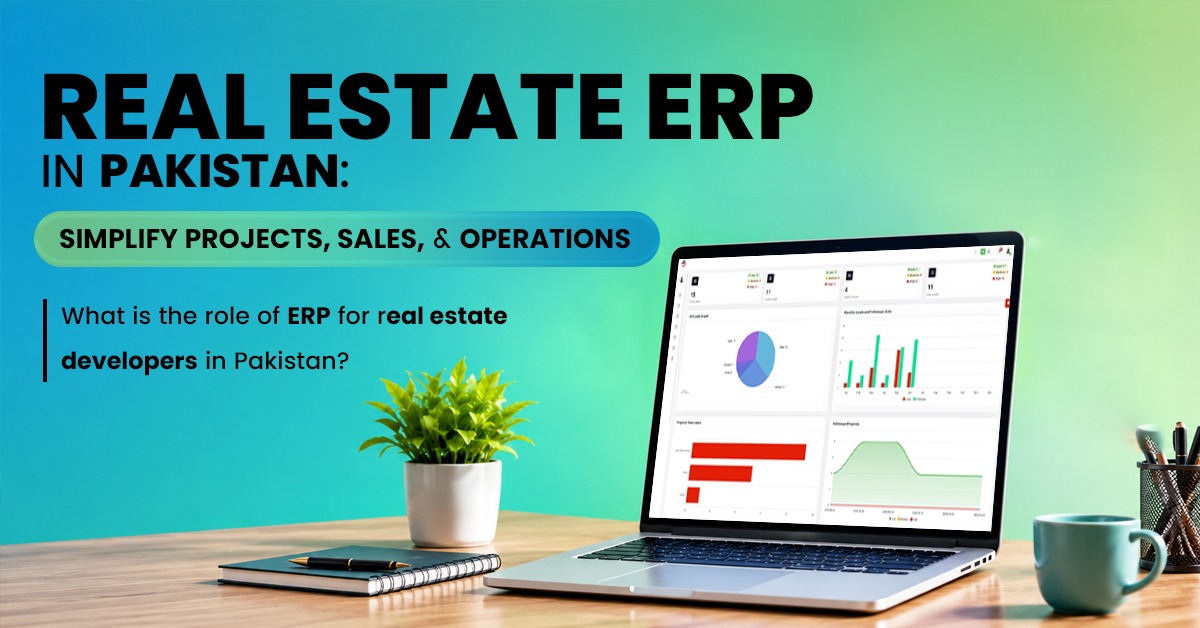
Accurate information is essential for developers to assess the project and find business opportunities. ERP dashboards and reports offer business insights on sales performance, finances, stock, and operations.
Organised data allows management to spot delays, keep track of performance, and make decisions using fresh business data.
Why Pakistani Developers Should Consider Real Estate ERP
With the growth of property businesses, manual processes become more challenging. The right ERP system can make it easier for developers to coordinate, keep accurate records, and minimize repetitive administrative tasks.
Ladder ERP from SHE Technologies, for instance, provides businesses with a chance to streamline crucial management procedures with integrated software solutions. The features, customization, reporting, and support are all important factors to consider when choosing an ERP platform for development.
Conclusion
Real Estate ERP software has the potential to revolutionize the way developers in Pakistan handle projects, sales, finances, construction, and customer relations. It centralizes all critical operations, provides better visibility, facilitates coordination, and aids businesses in dealing with the increasing workload.
The right ERP solution enables developers to dedicate less of their time to managing disparate information and more to project delivery, customer satisfaction, and future growth.
FAQs
1. What is Real Estate ERP software?
Real Estate ERP software is an integrated application system that assists property developers in managing project planning, sales, accounts, construction, inventory, and customer information.
2. What is the role of ERP for real estate developers in Pakistan?
It allows developers to streamline their business processes, schedule property rentals, streamline payment tracking, oversee construction projects, and boost inter-departmental coordination.
3. Can Real Estate ERP handle property bookings as well as installments?
Yes. Depending on the features, an ERP system can also keep a record of bookings, customer information, installment timelines, payment history, and pending balances.
4. Can ERP software be used for small real estate enterprises?
Yes. As small and growing property businesses grow, they can utilise ERP software to keep things well organised and to design their operations and processes in an efficient manner.
5. What are the key factors that should be taken into account while selecting the best Real Estate ERP?
So, before choosing a solution, developers should take into account their business needs, the features they need, the extent of customization, ease of use, integration options, reporting capabilities, and technical support.