



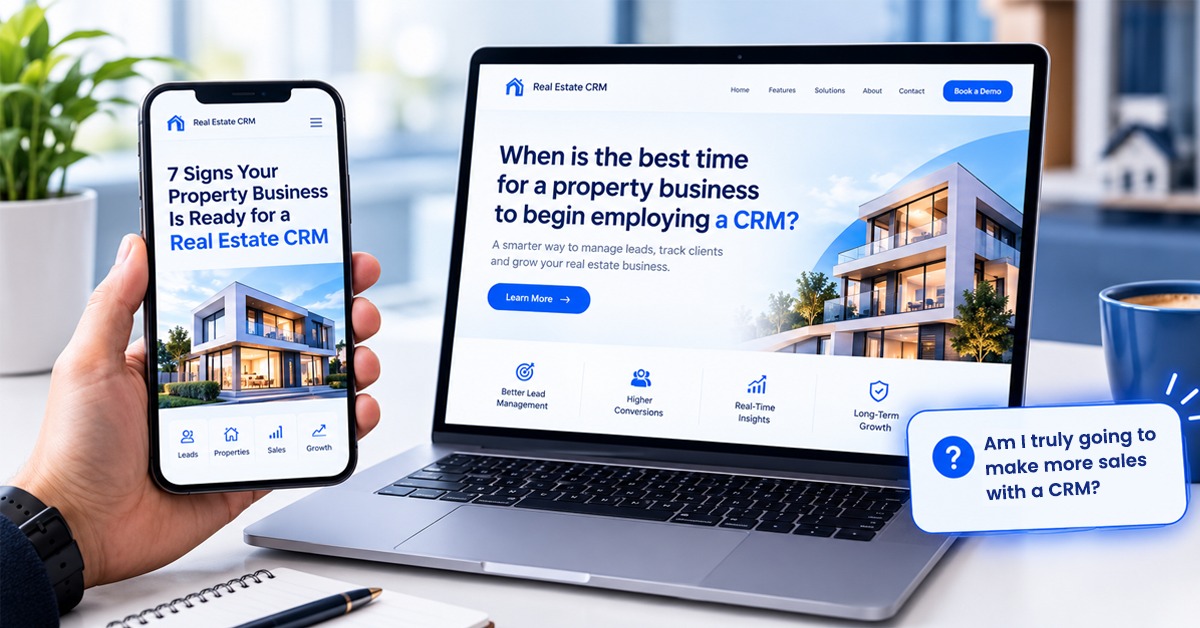
Many property businesses get going on a small scale, with phone contacts, notebooks, and Excel sheets. This is only for a time. However, when you start getting inquiries and employees, things start falling apart. When you see the following symptoms, you know it’s time for your business to start using a real estate CRM.
Sign 1: Leads Are Getting Lost or Forgotten
Customers are referred from Facebook ads, property websites, WhatsApp, your website, and in-person visits. Some are followed up when they are in different locations; yet some are never followed up. If you have ever left an old inquiry and figured no one called back, then you’re losing money. A CRM gathers all leads in one place and ensures they are assigned to someone with a follow-up action.
Sign 2: Memory-Reliant Sign 2: Follow-Ups Depend on Memory
The majority of buyers require a few chats before they book. Avoid following up if your agents can’t remember; sticky notes are used, or personal chat histories are used. A CRM reminder system reminds you when to call, meet, or visit a site and maintains notes from all your conversations, which can be carried on by the next person.
Sign 3: When you can't even see your sales pipeline:
If you can, how many leads are at the site visit stage, how many are in negotiation, and how many are close to booking right now? If it takes hours to answer because you have to ask around, you don’t have visibility. A CRM offers a graphical pipeline for visualising each deal’s phase, enabling sales forecasting and identifying the leaky points.
Sign 4: Your Team is growing
It’s simple to manage two agents. Ten is not. When the team expands, it’s the time to make sure it’s evenly distributed, everyone knows exactly what they’re responsible for, and it keeps everyone accountable. A CRM automatically assigns leads, tracks agent activity, and displays who is closing and who is in need of support.
Sign 5: Spreadsheets have become a headache!
While Excel is valuable, it becomes problematic with a lot of people editing the same file. There are duplicates, out-of-date versions, incorrect formulas, and missing data, causing confusion. When your team is spending more time on the sheets than on sales, it’s time to upgrade to a system that is designed to do the job.
Sign 6: You Don't Know Which Marketing Works
You might be paying for ads, portals, and promotions that you aren’t aware of, which attract real buyers. A CRM logs all leads and provides information about conversions to help you focus on the most effective marketing initiatives and eliminate the rest.
Sign: 7 is Client Communication Is Inconsistent.
Clients want fast responses, concise updates, and payment and appointment reminders. If messages are sent by hand from individual phones, there is variation in quality and records are lost. CRM that integrates WhatsApp, SMS, and email ensures organized communication, a professional appearance, and that records are saved in every client’s profile.
If you notice these symptoms, you should take the following steps:
If you hear two or three of these sounds familiar, you should begin to prepare for CRM rollout:
- Write down your issues and objectives. Determine which aspect of your website you want to optimize, like response rate or conversion rate.
- Outline your sales process. Establish stages from inquiry to closing.
- Select software that is geared towards real estate. Search for features such as inventory management, installment tracking, and support for local units like marla and kanal.
- Get a demo with your data. Perform a test with your team.
- Train your staff. Offer role-specific sessions and easy instructions.
- Start simple. Always use the main features first, and then add in the extras.
Final Thoughts
A CRM isn’t merely for large organizations. It’s for any property business that desires to react rapidly, observe and follow up regularly, and expand without chaos. When leads are evaporating, your team is expanding, or your data is disorganized – the longer you wait, the more deals you lose. Select a system that works for you, build a solid team, and make what you do a process that’s measurable and organized.
FAQs
1. When is the best time for a property business to begin employing a CRM
From the moment you get multiple leads, follow-ups, or agents. Beginning early establishes good habits and will avoid data issues down the road.
2. Do you need to implement a CRM system if you're not a large real estate firm?
Yes, organized leads, reminders, and reports are great for small agencies and individual agents, and many CRMs provide low-cost plans.
3. Can a CRM take the place of an Excel sheet entirely?
Yes, in most cases. Leads, inventory, and payments are all kept in one system in a CRM, while you will still be able to export data to Excel if necessary.
4. What are some red flags to watch out for when hiring a real estate CRM?
Most businesses go live in a few weeks, based on data import, customization, and training of staff.
5. Am I truly going to make more sales with a CRM?
It helps by enhancing the response time, consistency of follow-up, and pipeline visibility, which generally results in more site visits and bookings.