



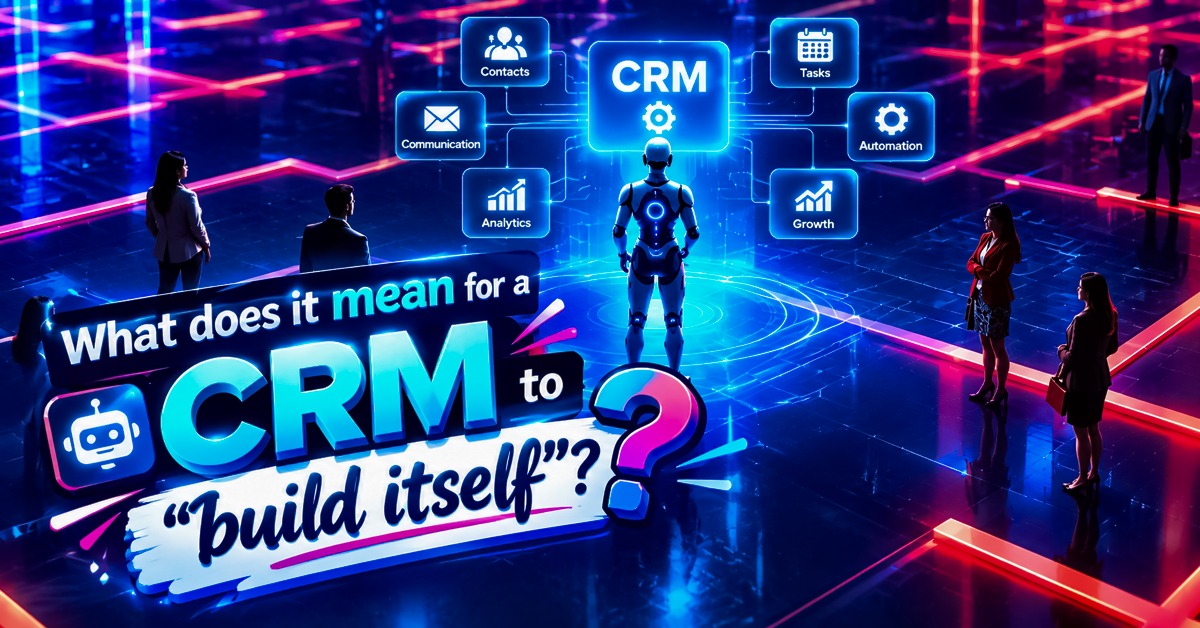
The role of the CRM is evolving from a tool sales teams log into to a system that sets itself up, updates itself, and optimizes itself using AI agents. In this blog, you’ll learn about what this shift means for the CIO’s job, why oversight is more important now than ever, and how technology leaders can remain in control as SaaS platforms become more autonomous.
Introduction
The typical use of a CRM, orchestrated for years, was a pattern of IT setting up the system, sales and marketing leveraging it, and updates being released at a known frequency dictated by the vendor. That tempo is changing. This new capability allows AI agents to be integrated directly into the CRM platform to modify workflows, create automations, and reconfigure processes based on real-time activity, without explicit user instruction.
From Tool to Autonomous System
The shift in industry discussions are talking of “agentic CRM” instead of automation operating on a set of rules. Agentic systems do not simply follow through on instructions but seek out results, review account activity, tweak outreach tactics, and adjust workflows based on what is working, not what is set up. Today, some vendors are providing no-code agent builders inside the platform so that the system can build and update workflows based on performance metrics, instead of only on the basis of a change request from IT teams.
It’s a significant shift from legacy CRM automation, which cut down on repetitive tasks but required people to initiate the process, manually trigger it, and feed it into a pre-programmed logic. Agentic systems, on the other hand, can take actions independently, deciding what to do next instead of simply recording the actions taken.
Why This Puts CIOs in a New Position
The classic IT governance approach of review, approve, deploy doesn’t fit the continuously adjusting system, as a CRM can change its workflows. Today, CIOs must be responsible for a platform that isn’t a simple set of software, but rather a continual decision-making process, creating new questions: So who’s on the hook for an unanticipated result when the autonomy adjustment is made? How to audit a self-modifying system? What safeguards help keep an agent from doing something that isn’t in his job description?
That’s not a theoretical issue, but rather, companies that have many AI agents connected to their CRM see a big boost in prior “vanilla” outreach efforts once they take the time to architect the approach, rather than simply plugging in an agentic feature.
What should be CIOs top priority?
- Set clear guidelines for agent autonomy. Establish the autonomy of agents in decision-making and what else needs to be approved by humans.
- Incorporate auditing into agents’ actions. When a workflow changes, it is important that there is a clear record of what changed, when, and why.
- Don’t assume data quality is a trivial problem. Autonomous agents rely on the data that is at their disposal; bad data is bad data right away, and there’s no human filter.
- Look for platforms with successfully developed native integration, as agents who have access to the full context within a system tend to achieve meaningful improvements in performance over agents that have disconnected, bolt-on AI integrations.
- Move away from configuration and towards oversight of IT. The role evolves from manual workflow creation to systems monitoring, correction, and control that are increasingly self-creating.
The Bigger Picture
The CRM market is reimagining itself around this change: Some vendors are adding agentic capabilities to their existing platforms, and others are constructing AI-first CRM systems from scratch. As CRMs become more independent, along with them should grow oversight, accountability, and data integrity, which is where the practical issue lies for CIOs, not necessarily who should be on one side or the other of this debate.
FAQs
1. What does it mean for a CRM to "build itself"?
These are AI agents in a CRM system that can adapt, restructure, or refine workflows and automations in real-time without the need for manual adjustments for each change.
2. What are the differences between agentic CRM and traditional CRM automation?
Traditional automation follows predefined rules and needs to be triggered by humans. Agentic systems seek outcomes and can operate in activities independently and change their conduct in response to time.
3. What new roles do CIOs take up?
CIOs need to define the limits of agent autonomy, make it possible to track actions taken, and control systems that are continually self-configuring and self-modifying.
4. Data Quality is of greater significance in an agentic CRM environment. Why?
Poor data quality can cause poor autonomous decisions, as autonomous agents are working on the data right away and humans never have a chance to review the data for obvious errors.
5. Do businesses need to completely rely on AI agents for managing customer relationships?
Not without safeguards. Best practice exists in a combination of agent autonomy for lower-stakes, repetitive decisions and human oversight where it is needed for higher-stakes and/or more ambiguous decisions.