



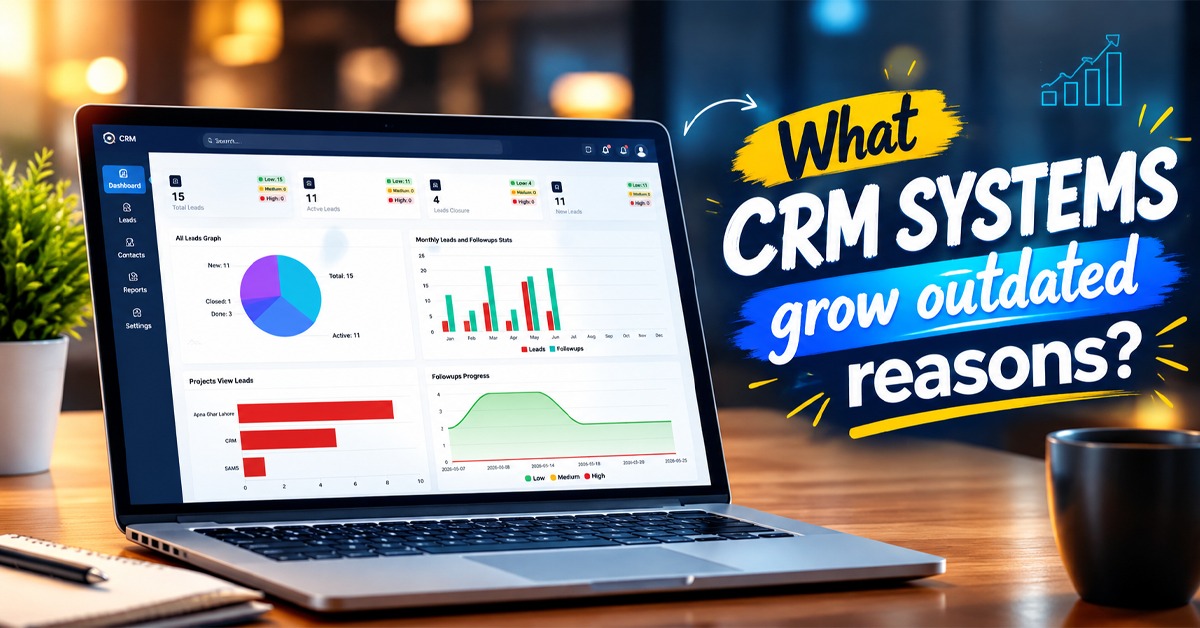
A CRM should not add more layers to customer management; it should make it easier. If not implemented correctly, if it contains out-of-date information, if it is poorly connected to the rest of the business, or if it is not widely used, a CRM can become a major business obstacle. These five practical solutions can help organizations prevent common CRM failures and create a CRM system that is going to continue to benefit them.
Introduction
A customer relationship management (CRM) solution is typically implemented to centralize customer information, sales interactions, communications, and business processes. However, several CRM projects do not yield the desired outcome due to the fact that companies concentrate more on the software purchase than on implementation, data quality, employee adoption, and continuous management.
Over time, Legacy CRM challenges can impact productivity. Employees can begin to develop workarounds; customer information can become stale; and teams can start using disconnected applications and spreadsheets.
To prevent these issues, a multi-layered approach is necessary, not just choosing a modern platform.
The first thing to do is to consider business requirements, not software features.
Many times, one of the biggest CRM errors made is getting the right features on a long list. While a system can have dozens of capabilities, these aren’t necessarily relevant to the organisation.
Before establishing a CRM, companies need to find out what problems they need to solve. This could be the lack of robust lead tracking, lack of customer data integration, weak follow-up systems, lack of reporting, or disjointed sales and support.
1. Consider the software's ability to fulfill their operational requirements.
Business assets are used to run a business.CRM Data is treated as a Business Asset for running the business.
The value of a CRM depends on the data that is contained within it. Reports and data automation can be less reliable due to duplications, missing contact information, inaccurate customer information, and inconsistent data entry.
2. Treat CRM Data as a Business Asset
Organizations need to clean, standardize, and organize data prior to migration from an older system. Clear policies and procedures should also specify how staff build, edit, and store customer data.
By running the data-quality checks regularly, the data in the CRM will not just slowly fill up with incorrect data.
3. Make Integration a Priority
A CRM isn’t usually utilized alone. A business might already have accounting software, an email system, a marketing solution, a support solution, a communication app, and other business applications.
If these systems aren’t connected, workers might be required to input the same data several times. This makes it more difficult to work manually and places an increased risk of errors.
Therefore, integration is a key factor that should be taken into account in a modern CRM strategy. Integrating appropriate systems can provide a more streamlined information-sharing process and minimize duplicate paperwork.
4. Plan for employees, not management.
While a CRM can offer managers fantastic dashboards, it can additionally fail if employees aren’t able to use it efficiently.
Usability should be taken into account when implementing. Employees should be provided with clear workflows, processes that are easy to follow, appropriate fields, and training based on their real job tasks.
Organizations should also take feedback post-launch. When employees keep avoiding some of its features and get around it by doing manual tasks, these can be signs that the system can be improved.
5. Seek to continuously improve
The implementation of CRM should be considered as a project that will not be a one-time thing. Expectations, processes, technologies, and organizational needs of customers are constantly evolving.
By regularly reviewing, businesses can see where their workflows are falling behind, where fields can be removed, where there are integration issues, and where new opportunities for automation exist. AI can also be incrementally adopted, making adopting a specific feature a priority in specific moments.
A continuous improvement strategy is one way to ensure that a CRM isn’t left as a legacy system over time.
Conclusion
The failure of a CRM is much more likely to be due to faulty people than to faulty software. Issues typically arise when businesses neglect to consider data quality, integration, employee experience,e or the needs of the business, or when they fail to maintain systems.
With clear objectives, accurate data, meaningful and relevant applications, user-oriented design, and constant improvement, organizations can build a CRM system that enhances and empowers business growth and development.
It’s not just the fact that they’re switching from an old CRM to a newer one. It’s about creating a customer system that is going to grow together with the company.
FAQs
What CRM systems grow outdated reasons?
As business needs evolve and workflows, data frameworks, and integrations change and are not adequately reviewed, CRMs can quickly become outdated.
The main reasons why CRM is considered a failure?
User adoption is a significant challenge. If users don’t like the system or don’t think it applies to their work, they are not likely to use the system or practice it in another way.
3. What are the consequences of bad CRM data for a business?
Inaccurate or incomplete data can cripple reporting, customer communications, sales forecasting, automation, and decision-making.
Why is it that CRM integrations are crucial?
Integrations enable data to flow between business apps and avoid duplicate data entry and inconsistent data that can slow teams down.
5. What are some ways that businesses can maintain long-term effectiveness of CRM?
Revise workflows regularly, purge customer data, track user feedback, keep integrations up to date, and add training and improvements as needs change.