



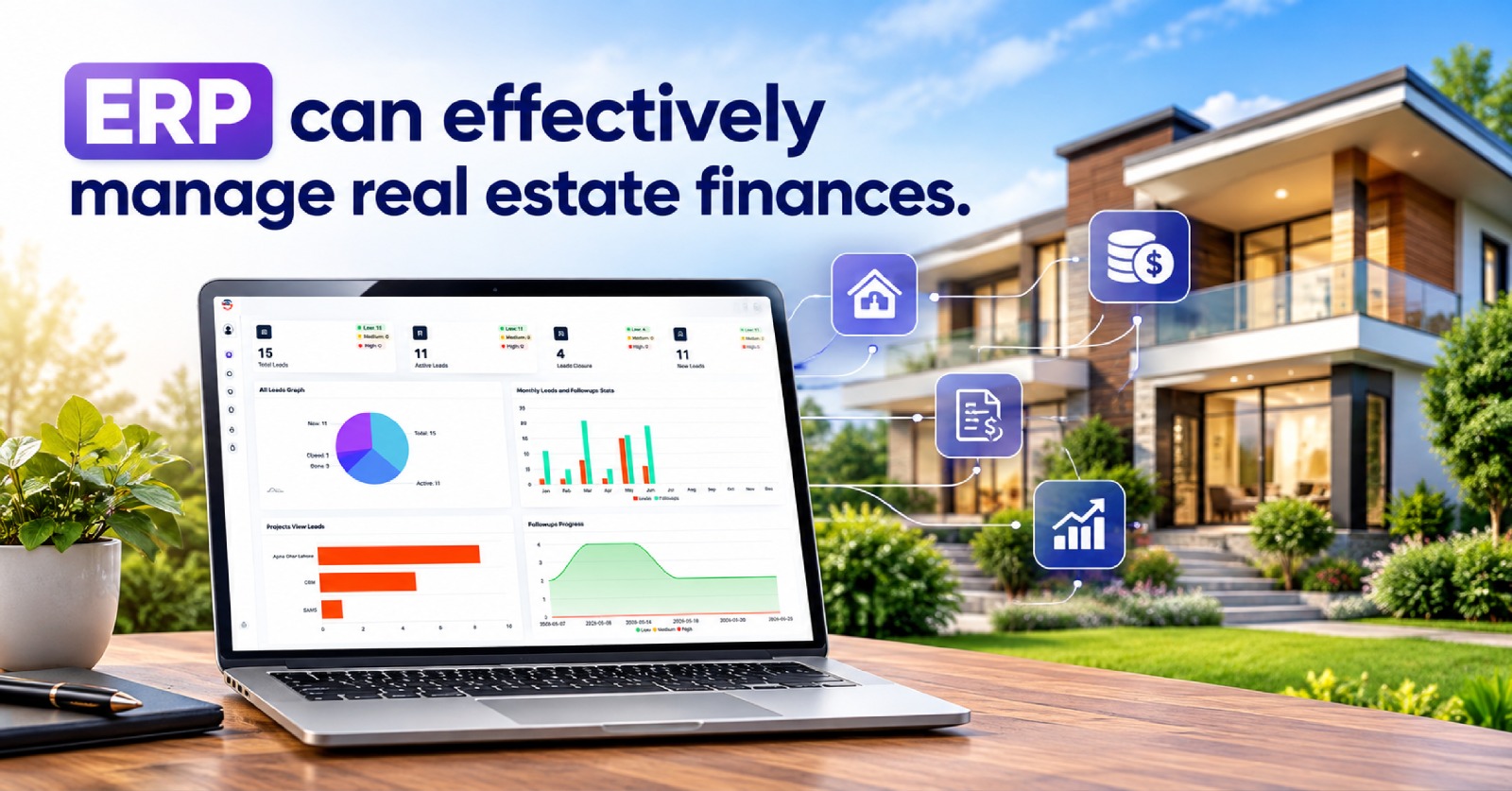
Operating a real estate business is more than just the buying and selling of real estate. All teams need to handle projects, customers, finances, documents, sales, employees, inventory, payments, and daily operations in parallel. With these activities being managed by individual spreadsheets and applications, it becomes challenging to keep them all in sync.
This is where Enterprise Resource Planning (ERP) software can come in handy. The ERP integrates various business processes into a unified system, providing real estate businesses with a more comprehensive view of their operations.
What is ERP, anyway?
ERP software in its basic form integrates various departments and business processes on a single platform. In the past, financial data was stored in one application, customer data in another, and project information in a third. That was no longer the case, since businesses could now handle these processes in an integrated environment.
In a real estate firm, this can imply linking sales, accounts, projects, customer control, documentation, human resources, and other activities.
The primary goal isn’t just to store information. It’s designed to enable various business components to interact with data that is connected and consistent.
The importance of ERP in real estate.
Large real estate enterprises deal with a considerable quantity of information on a daily basis. Many internal teams, documents, financial transactions, contractors, suppliers, agents, buyers, and sellers may be involved in a single project.
An ERP can help with all these activities to ensure that employees have access to information when it matters.
The sales team, for instance, can control customer data, and the accounts team can monitor payments and financial documentation. Management can then use the wider operational data without having to make a separate report from each department.
Better Financial Management
One of the most critical aspects for any property business is financial management. Real estate firms can record payments, costs, receivables, invoices, commissions, and project costs.
An ERP can bring these data together and integrate the financial data with other business activities. This can help management to see where the money is coming from, where the money is going, and which transactions need to be attended to.
Maintain Property and Project Information:
Real estate companies have a tendency to handle more than one property and project at a time. Maintaining consistency of information in multiple files can be a burdensome task.
An ERP can offer a centralized system to store and handle project-related data. You can categorize records by projects, properties, customers, transactions, and other business categories.
This can help to make information easier to access if employees need it.
Integrate Sales and Customer Management Systems.
The real estate sale is not likely to occur on the first meeting. Customers can ask questions, make appointments, talk about payment options, inquire about homes, and ask for several callbacks.
Integrated ERP can link the information of customer and sales with all other operations records. This minimizes the need to transfer data back and forth between unconnected applications.
ERP and CRM systems can be integrated for customers and sales activities, delivering a wider perspective for businesses that need to have a dedicated customer relationship system.
Access centralized information to make better decisions.
The biggest advantage of ERP is increased visibility. If information from various departments is linked, managers will have to spend less time gathering data manually.
Reports and dashboards can be used to gain insights into sales performance, financial activity, projects, customer activity, and operational progress.
However, having greater visibility does not necessarily mean making better decisions, but it does provide decision makers with a more structured information base upon which to make those decisions.
The ERP solution for growing real estate businesses.
Manual processes can become more difficult to manage as a real estate firm grows. As the number of employees, projects, customers, transactions, and documents increase, so does complexity.
A real estate ERP can play a vital role in enabling businesses to create structured processes around this growth. For instance, Ladder ERP by SHE Technologies is currently part of a system that is developed to facilitate real estate business operations and use connected digital tools.
The ultimate goal is for the right ERP to adapt to workflows, not the other way around.
The Simple Answer
So, what does an ERP do for a real estate company?
It links business activities.
Whether it’s finance and sales, customer management, projects, documents, or internal processes, ERP software gives real estate companies a centralized hub to manage information and coordinate daily operations.
The true value is when departments work in an integrated way, not in disjointed silos, but from connected data.
FAQs
1. The ERP software for a real estate company is a program that integrates various sales, marketing, finance, and admin tasks.
Real estate ERP software is an integrated business platform that can integrate such activities as sales, finance, project, customer management, documentation, among others.
2. What are the benefits of ERP for real estate companies?
It can help you centralize business data, integrate departments, minimize manual work with data, enhance reporting, and give more visibility into operations.
3. ERP can effectively manage real estate finances.
Yes. ERP software may help with financial processes like payments, invoicing, expenses, receivables, commissions, and project finances, depending on the system.
4. How do you see 4.0 ERP and CRM systems working together in real estate?
A CRM deals with customers, leads, interactions, and sales relationships, and an ERP ties in all other aspects of business, including finance, projects, inventory, HR, and administration.
5. Does the real estate firm need ERP?
Yes. An integrated ERP can assist in managing more complex operations and processes, as well as providing a more streamlined workflow across different departments, as the business expands.