



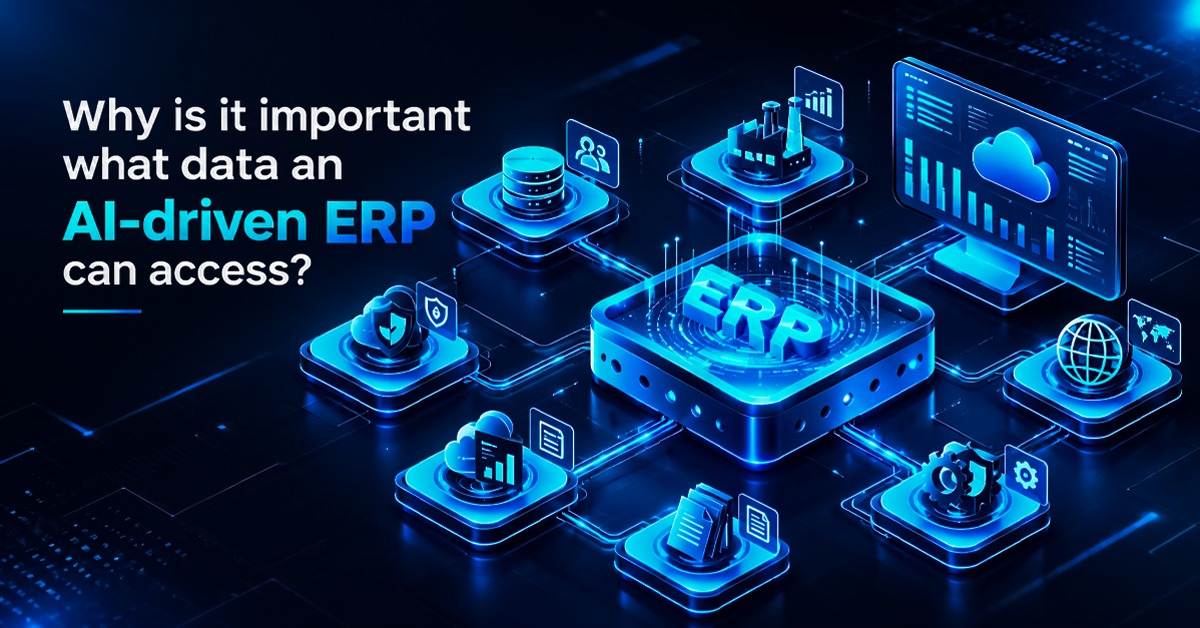
All ERP companies these days boast some version of “AI-powered” — smarter forecasting, instant answers, automated insights. But the difference between a great sales demo and a successful daily tool is where the majority of tech budgets go under the radar. The right questions can bring out the truth for you before you enter into a contract. You’re not purchasing an actual business instrument; you’re purchasing an expensive presentation.
Begin with what the AI can see.
Access to data is the first question that should always be asked. If it’s just a narrow view of your system that an AI tool can see, it will only have a narrow view of your business. The best AI-ERP solutions can now access the data that powers the company — not just a partial dashboard view atop the actual system, such as the general ledger, budgets, customers and vendors, inventory, and sales and purchasing transactions.
What is the real location of the AI?
While ERP buyers may only be looking at one vendor, they are actually considering two: the ERP vendor and the AI vendor that powers the ERP’s “intelligent” capabilities. A direct question should be raised if the AI model is to be implemented as an infrastructure layer or integrated into the core applications, as it will impact performance and future flexibility.
The concept of Pricing Exposure and how it works.
Often, AI features are priced on top of the ERP base license, which can change independently. A seemingly good monthly rate at the start of the sales cycle can quickly turn into a wild guess based on the actual number of instances used during business use, and that should be clearly defined from the beginning, not on a future bill.
Address Data Portability
Can your organization’s legacy data and configuration be migrated when the underlying AI provider changes, perhaps due to an acquisition, platform transition, or when the vendor’s partnership is cancelled? However, this is rarely discussed unless the buyer explicitly inquires about it, and it may be a big deal if you ever want to change platforms.
A trustworthy AI system needs to allow users to attribute an answer to where it actually is. Can an AI indicate that there are cash-flow issues in the next few weeks and demonstrate the underlying transactions and assumptions that led to that result? An answer that doesn’t come with an explanation is a number that can only be second-guessed.
What is the integration with other than the system?
No business is built without ERP. Seamless integration with CRM, HR, and other key systems is becoming paramount, as the more data that’s integrated, the more valuable insights AI can generate. Ask vendors straight-up how they perform AI functions with the rest of your business infrastructure.
The Question That Matters Most
When considering the next ERP system for your business, one question should stand out: When the AI “goes wrong,” will your business detect it in time before the error turns into a much bigger issue? A vendor that does not have a clear answer on this regarding human oversight, audit trails, and error correction is a vendor to be probed deeper before committing to any contract.
FAQs
1. Why is it important what data an AI-driven ERP can access?
Any AI tool with only a small portion of your system will provide limited insight—a comprehensive, valuable insight requires access to your core financial, inventory, and transaction information.
2. Do ERP systems come with AI capabilities at a higher cost than they would without them?
Often yes. Of particular concern is the fact that AI usage comes with its own usage-based pricing, meaning that it increases in tandem with the base ERP license, which is crucial to understand before signing on the dotted line.
3. If a vendor changes AI providers, what happens to the AI-trained configurations?
This depends on the vendor, which is why it is important to verify data portability, as some systems can move historical data and configurations, while others cannot.
4. Why is explainability important in AI-powered ERP tools?
An AI that fails to provide explanation or reasoning cannot be checked for correctness or reliability by the user. If an AI model does not provide any explanation or reasoning, it is impossible for the user to verify or trust its recommendations.
5. Which is the most crucial question to consider before purchasing AI-driven ERP?
Whether your business will be able to detect an AI mistake before it gets out of hand, because human processes of oversight and error correction are just as important as the AI’s own performance.