



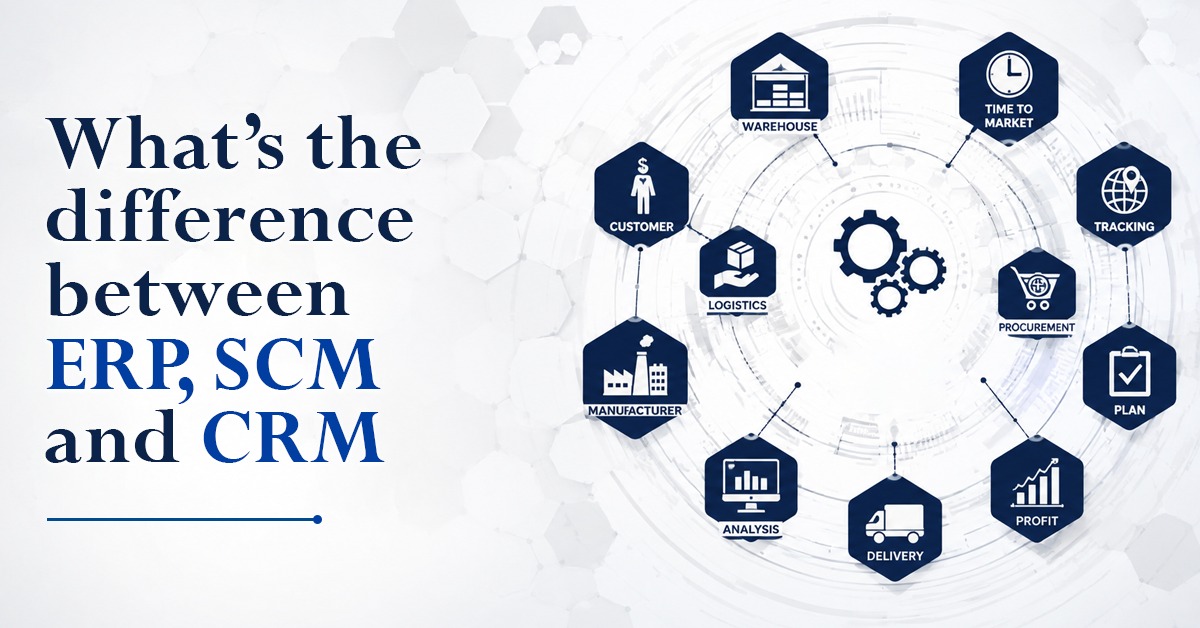
The retail technology landscape in 2026 is shifting from a collection of disparate software solutions to a system of connected technologies that can power the customer and business experience throughout. Retailers are increasingly using ERP, supply chain management (SCM), and customer relationship management (CRM) systems to handle and oversee their inventory, suppliers, money, sales, and customers.
The transition is driven by retailers’ evolving consumer demands, increasingly complex supply chains, increasing operational costs, and increased demand for faster digital experiences. Many enterprises are considering how ERP, SC, and CRM can be integrated to provide a more streamlined retail operation.
The business ground of ERP is changing.
In the past, ERP systems have been used to control core business processes like accounting, purchasing, inventory, human resources, and financial reporting. However, ERP systems are increasingly being integrated into sales and supply chain processes in today’s fast-moving retail landscape.
Having an integrated ERP system can help management teams to have a better view of how their business is performing. Financial details can be correlated with purchase, stock, sales, and operations details, allowing for better insight into where the money is going and how each department is doing.
This centralized solution can also help decrease information gaps for retailers with multiple stores or sales channels. Employees can collaborate with data in an integrated business context, rather than using standalone spreadsheets and handcrafted reports.
Smart supply chains are coming. Smart Supply Chains on the way.
Retailers have been forced to pay close attention to their supply chain over the last few years, after years of chaos in both global markets and the supply chain. Since those times, scarcity of products, transportation delays, changing demand, and problems with suppliers have proven the value of increased supply chain visibility.
Retailers can use SCM software to track their purchasing, suppliers, inventory movement, warehousing, and logistics. Improper information flow in the supply chain can lead to delayed decisions on replenishment and distribution, which can be detrimental to business. Efficient information flow within the supply chain can help businesses to make timely decisions regarding replenishment and distribution.
These are complemented by AI and analytics. Retailers are becoming more efficient at forecasting and understanding potential supply issues by analyzing demand patterns and other business indicators as they become larger operational problems.
CRM is no longer about contacts.
Customer relationship management is also changing. Today’s CRM systems are not only used to store customer names and contact information. CRM platforms are beneficial for retail businesses for lead management, customer interactions, marketing efforts, sales processes, customer service requests, and follow-ups.
Customer data is extremely valuable in the era of online/omnichannel retail. Consumers can engage with the retailer via a web platform, social media, mobile app, retail store, or customer service.
A well-integrated CRM can help to create a more comprehensive picture of those interactions. This can help facilitate better contextual communication and enable sales and service teams to have more context to respond.
The issue is getting bigger.
What’s really revolutionary in retail technology isn’t necessarily the specific functionality of the ERP, SCM, or CRM alone, but how they communicate.
Suppose a customer places an online order. Suppose a customer ordered something online. Customer interaction can be tracked, financial transactions can be managed, and inventory and fulfillment can be handled by the SCM system. If these systems are linked up, data may be exchanged between departments without having to be entered multiple times.
This can help to minimize manual efforts and give managers more accurate information to make decisions.
AI is putting pressure on modernisation.
AI is helping to spur an interest in connected retail technology. With the rise of AI tools, data integration plays a crucial role in ensuring that this technology generates insights that are both valuable and accessible.
AI can help retailers with demand forecasting, custom product recommendations, customer support, fraud prevention, pricing strategies, and marketing efforts. These abilities, however, rely heavily on the quality of the underlying business data.
This means that retailers might start to consider ERP, SCM, and CRM solutions as the base layer for other more sophisticated AI solutions.
Retailers are advised to keep an eye on several factors for 2026.
Automation, integration, analytics, mobile access, cloud platforms, and AI-driven decision-making will likely be key priorities for the retail tech sector in 2026.
But the use of technology is not enough to ensure positive outcomes. Retailers must determine their business problems before considering the purchase or upgrade of systems. Another factor to take into account is scalability, as well as cybersecurity, employee training, integration needs, and current data quality to be on board with the new system.
Retailers are driven more and more to build an ecosystem where financial operations, supply chain activities, and customer relations are interconnected and not treated as separate functions.
A connected foundation can empower businesses to adapt to shifting demands, optimize operations, and provide customers with consistent experiences, as competition grows.
FAQs
1. What's the difference between ERP, SCM and CRM?
ERP handles the core operations and financial processes of your business, SCM deals with the supply chain functions, and CRM is responsible for customer relations, sales, and interactions.
2. What are the benefits of ERP, SCM, and CRM for retailers?
These systems, combined, can facilitate the linking of financial management, inventory, supply chain operations, sales, and customer engagement for retailers.
3. Is there an ability to integrate ERP, SCM and CRM systems?
Yes. Integration enables information to flow between various business functions, minimizing unnecessary data duplication and facilitating visibility across operations.
4. What are the potential challenges and risks that lie ahead for retail software in 2026?
AI is used to aid forecasting, personalization, customer service, fraud detection, pricing, analytics, and automation.
5. What are some factors that retailers need to take into account when upgrading their systems?
Retailers need to weigh business needs, scalability, integration, security, data quality, employee training, costs, and the value of the technology.