



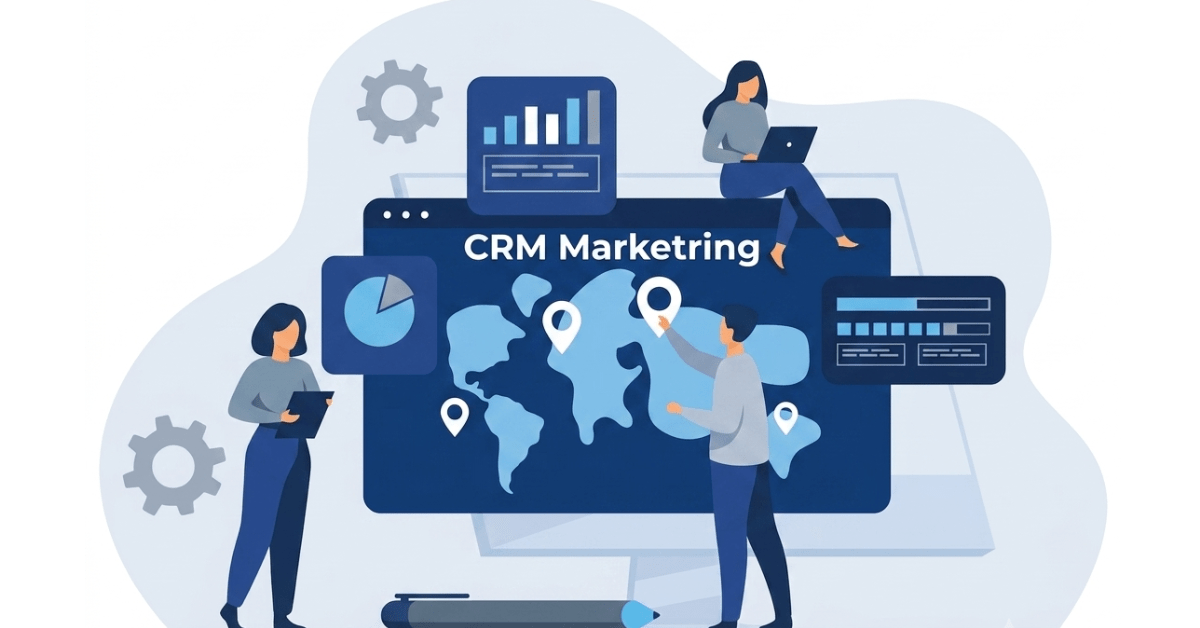
Today’s business environment has become digital, and the boundaries between customer relationship management (CRM) and marketing have become nearly indistinguishable. It used to be a system to manage customer engagement, and now it has become one of the most effective marketing tools in any organization. However, when did CRM actually become marketing – and how was it so easy to transition?
The Traditional Use of CRM.
CRM systems were originally developed to handle customer data. The business utilized CRM tools to keep customer records, monitor sales deals, and recall customer correspondence. CRM systems were essential for sales teams to keep track of their sales pipeline, leads, and close deals efficiently.
Marketing was different, existing on its own. Different tools were used to plan campaigns, data was sometimes isolated, and customer insights were limited. The separation between lead generation (marketing) and lead conversion (sales) was quite evident.
The Shift Begins: Data Becomes the Core
It all began with the shift towards data becoming the main focus. Companies began to see that the information about their customers was not only valuable for sales, but it was also a treasure trove of customer behavior, preferences, and buying patterns.
CRM systems grew to include more complex and richer data sets:
- Purchase history
- Website interactions
- Email engagement
- Customer feedback
This kind of visibility gave marketing teams the opportunity to leverage CRM systems for more targeted and personalized marketing.
Automation Changes Everything
The real turning point came when marketing automation came along. CRM platforms began to add automation capabilities that enable companies to:
Send customized e-mail campaigns.
- Send out messages that are triggered by user activity.
- Use segmentation with accuracy. Use segmentation accurately.
- Nurture leads automatically
The moment had come, and CRM was no longer a database, but a communication hub. Marketing teams would now be able to create campaigns directly from within their CRM systems, which would eliminate the need to use other tools.
The transformation of marketing from a product to a customer focus.The shift from product to customer marketing.
The second was the move towards customer-centric strategies. Today’s consumers demand a customized experience, immediate reply times, and seamless communication channels.
CRM systems were able to do this because they provided a single source of truth. Marketers could now:
- Track the entire customer journey
- Send personalized messages at the right time.
- Connect campaigns to real-time actions.
This synergy of data and communication is what really made CRM a marketing machine.
The integration of Digital Channels.
With the rise of digital channels such as social media, emails, mobile apps, and websites, CRM platforms quickly evolved. Numerous systems are now readily compatible with:
- Social media platforms
- Email marketing tools
- E-commerce systems
- Advertising networks
This integration enables marketers to run campaigns, monitor results, and fine-tune strategies entirely within a CRM system.
CRM is a Growth Engine.CRM is a growth engine.
CRM has evolved from a sales support tool to a key enabler of business growth today. Companies use CRM systems to:
- Develop repeat sales. Develop repeat customers.
- Improve customer retention
- Increase lifetime value
- Provide a uniformly branded experience
Marketing and CRM have become intricately linked, sometimes sharing the same resources and teams and frequently combined in the same platforms.
Why It Happened So Quietly
It’s not as though the change from CRM to marketing was sudden. It was slow and progressive and had been initiated by:
Technological advancements
Personalization is becoming a growing demand. The need for personalization grows.
The business necessity of data-driven decision-making.Business requirement of data-driven decision-making.
The use and integration of automation tools.Automation tools integration.
But these changes were gradual, and it wasn’t until after CRM had become a fundamental part of their marketing that businesses realized that they had transformed.
The Future: Unified Platforms
Future change is likely to make the line between CRM and marketing completely different. Modern platforms are becoming single platforms that integrate:
- CRM
- Marketing automation
- Customer support
- Analytics
This holistic system makes it possible for companies to deal with the entire customer journey from one location, which enhances effectiveness and ensures better interactions.
FAQs
1. What is the main difference between traditional CRM and modern CRM?
Customer Relationship Management (CRM) traditionally meant storing customer data and assisting the sales team, whereas modern CRM encompasses marketing automation, analysis, and customer engagement tools.
2. What role does CRM play in marketing in today's world?
CRM offers comprehensive customer information that enables marketers to tailor their campaigns, ensuring they are personalized and targeted, resulting in higher engagement and conversion rates.
3. What are the chances of small businesses successfully implementing CRM marketing integration?
Indeed, CRM systems are something that small businesses can use to automate their marketing, manage their customer relationships, and ultimately beat the large competition.
4. How does CRM enhance the Customer Experience?
CRM systems are used to manage customer interactions through all channels, so that businesses can effectively communicate consistently with each customer.
5. Are CRM tools taking the place of marketing tools?
Not completely, but many CRM platforms today have incorporated marketing capabilities, streamlining the CRM system and eliminating the need for additional tools.