



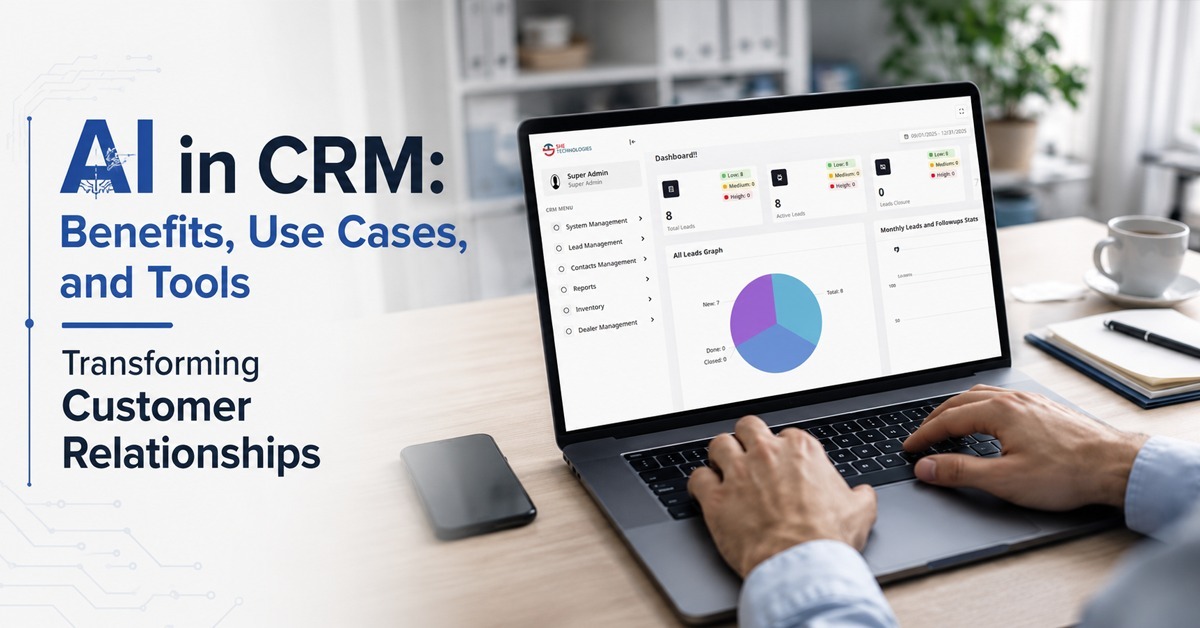
Customer Relationship Management (CRM) systems have come a long way from just contact databases. Today, CRM platforms are equipped with Artificial Intelligence (AI), making them more than just tools for managing customer interactions; they are engines that help make smarter decisions, automate repetitive tasks, and deliver personalised customer experiences. The new power of CRM platforms lies in the integration of Artificial Intelligence (AI), which transforms them into engines that make smarter decisions, automate repetitive tasks, and provide personalised customer experiences. In the modern era of business, Artificial Intelligence (AI) plays a crucial role in CRM, offering valuable insights, enhancing engagement, and ensuring competitiveness in the rapidly evolving digital landscape.
What is AI in CRM?
AI in CRM involves leveraging machine learning, data analysis, and automation to improve customer interactions. AI-driven CRM systems can analyze customer behavior, anticipate needs, and automate mundane tasks, eliminating the need for manual data entry and limited reporting capabilities.
This change equips businesses with the ability to shift from reactive customer management to proactive and predictive engagement.
Key Benefits of AI in CRM
1. Improved Customer Insights
AI is used to provide insights into patterns and preferences from large sets of customer data. It helps businesses gain deeper insights into customer needs, buying behavior, and engagement patterns, which facilitates more personalized interactions with customers.
2. Enhanced Automation
Simple activities like responding to emails, follow-up and entry of data can be automated. This helps decrease workload and enable teams to concentrate on strategic matters, such as establishing relationships and expanding sales.
3. Better Decision-Making
Real time insights and forecasts are possible with AI-driven analytics. Managers are able to make informed decisions on what information they should, and do not, assume.
4. Increased Sales Efficiency
AI can assist in identifying quality leads and anticipate the likelihood of conversion of prospects. Salespeople can focus efforts and convert leads into sales quicker.
5. Personalized Customer Experience
AI can provide businesses with personalised recommendations, targeted campaigns, customised messaging, and more, resulting in improved customer satisfaction and loyalty.
Top Use Cases of AI in CRM
Predictive Sales Forecasting
Historical data is used to inform the prediction of future trends using AI models. This allows businesses to strategically manage their stock, marketing plans, and resource usage.
Chatbots and Virtual Assistants
Customer queries are answered promptly with AI-powered chatbots, resulting in faster response times and availability. They also cut down on customer support costs.
Customer Segmentation
AI automatically categorizes customers by their actions, characteristics, and choices. This can help to create marketing campaigns that are very targeted.
Lead Scoring
AI rates leads according to the probability of converting the lead to a sale. Sales teams can target “hot prospects” and boost efficiency and performance.
Sentiment Analysis
AI tools are used to analyse customer feedback, reviews, and social media interactions to gain insight into customer sentiment. This allows companies to enhance their services and proactively solve problems.
The most widely used AI tools for CRM systems.
Today, CRM systems are increasingly equipped with AI features. Gone are the days of basic analytics and workflow capabilities, as automated analytics dashboards, intelligent recommendation engines, and workflow automation systems are now commonplace.
These tools not only help to make operations more efficient but also give a competitive advantage by making it possible to have faster and more intelligent customer engagement strategies.
How Innovation is contributing to CRM Growth
AI-driven CRM solutions are playing a vital role in digital transformation as businesses continue to embrace it. SHE Technologies is part of this transformation, providing companies with cutting-edge CRM solutions equipped with powerful capabilities such as AI-driven insights, automation, and scalability, all designed to meet contemporary business demands.
Future of AI in CRM
Overall, the future of AI in CRM is quite promising, as the technology continues to evolve and become more sophisticated. More sophisticated systems with real-time personalization and voice interaction, and more predictive analytics, can be expected in the future.
By investing in AI-powered CRM today, businesses will be better equipped to meet the challenges and opportunities of tomorrow.
Conclusion
In today’s fiercely competitive business landscape, AI tools within CRM cannot be ignored; they are essential for ensuring success. Whether it’s personalizing customer experiences or streamlining processes, AI is reshaping the way businesses interact with their customers and work towards success.
AI-driven CRM tools offer a way for businesses to achieve greater efficiencies, innovation, and customer satisfaction.
FAQs
1. What is AI in CRM?
AI in CRM involves leveraging cutting-edge technologies, such as machine learning, to automate workflows, analyze customer data, and enhance decision-making processes.
2. How can AI enhance the customer relationship?
It offers customized experiences, quicker reactions, and improved customer demands grasping.
3. Can small businesses use AI in their Customer Relationship Management (CRM)?
Yes, there are CRM solutions that are scalable and affordable, which can be used by companies of any size.
4. What are the primary tools that are employed in AI-driven CRM?
Some popular ones are chatbots, predictive analytics, lead scoring systems, and automation platforms.
5. What are the implications of AI for businesses in the field of customer relationship management (CRM)?
Advanced personalization, real-time data insights, and enhanced integration with new technologies, such as voice assistants and IoT, are all in the future.